Marin: The Place, The People | Prologue

by Jane Futcher

Prologue

The sweeping spans of the Golden Gate Bridge reach northward toward Marin County, their orange cables brilliant against the hills beyond. Far below is the mile-wide channel where San Francisco Bay joins the Pacific Ocean. To the east is the widening mouth of the bay, punctuated by an island of rock —Alcatraz, once America’s toughest federal prison, now a tourists’ mecca; to the west lies the Pacific.

Before us, where the bridge bows and rests, are the rugged cliffs of the Marin Headlands. Three million years of geological upheaval, of folding, faulting and uplifting created those ridges, which are part of California’s Coast Range mountains. The cliffs drop abruptly into the churning surf of the Golden Gate Channel. We descend more slowly, rolling onto the Headlands like a whisper-jet arriving in another country. The city is behind us, the chilling fog is gone. The sun breaks through the clouds, casting white light on the stucco homes of Sausalito. Wind flattens the grassy fields of Tiburon, Strawberry Point, and Angel Island. The peaks and sloping ridges of Mount Tamalpais stretch before us. We have entered Marin.

Marin. A triangular peninsula whose western shores are flanked by the Pacific Ocean and whose eastern shores are formed by San Francisco Bay. Her only neighbor is Sonoma County, to the north. Marin. In land area, fourth smallest of California’s fifty-eight counties; in population, twenty-sixth smallest; in median income level, number one; in per capita income, number four. Affluent Marin. Beautiful Marin. Home of Muir Woods and virgin redwoods, of Point Reyes National Seashore, of the Golden Gate National Recreation Area, of Mountain Tamalpais and vie other state parks. One-third of the county is public parkland, all just a bridge ride from San Francisco, little more than that from Oakland, Berkeley, and the other cities of the East Bay. No major metropolitan area in the world enjoys such a large and dramatically beautiful public space so nearby.

“I live in Marin,” someone tells you at a party. You nod; perhaps you even smile. For already you imagine a bubbling hot-tub, a plump portfolio of stocks and bond, a redwood deck landscaped wit red geraniums and marijuana plants. You are speaking, you assume, to an upper-middle-class professional with a job in San Francisco and liberal political leanings. Your Marinite rides a ten-speed on weekends, attends aikido class on Tuesday nights, and puts bean sprouts on Big Macs. If married, has been divorced at least once, and has recently left primal therapy for receptive-listening classes in Mill Valley. If you stick around long enough, you will probably find that on a few counts you have guessed correctly.

There is a stereotype of Marin County and its residents; occasionally you will meet someone who fits it. But your stereotype will prevail only if yo refuse tenaciously to explore the county’s coastal hills and rural interior; only if you avoid her tiny fishing villages and friendly, sunlit cafes; only if you never speak to anyone you meet and keep your eyes firmly to the road.

For if you look more closely at Marin, if you walk through the sunken valleys of Point Reyes, talk to an old-timer on the streets of Novato, or stop for a drink at Sausalito’s no name bar, you will find your stereotype vanishing. You will see that Marin is more than a playground for the rich.

You will find militant political activists as well as dilettantes, newly arrived organic gardeners as well as dairy ranchers whose families have lived in Marin for over one hundred years. You will discover Marin’s colorful history: her early days, when the county was proud to be one of the original twenty-seven created by California’s first state legislature in 1850. You will hear of the railroads and ferries — in the 1880s and ‘90s —that opened the county to developers and summer residents from San Francisco, many of whom would settle permanently after the 1906 earthquake and fire. But it was the completion of the Golden Gate Bridge in 1937 that made Marin the accessible bedroom community it is today.

Marin County is a curious mix of affluence and idealism, of isolationism and innovation. Socialites and houseboat artists lie down in front of bulldozers to protest the invasion of Sausalito’s waterfront community by profit-seeking developers. Business and Zen Buddhists attend public hearings to discuss the fate of a coastal valley. Single mothers and senior citizens tangle with county supervisors over the need for low-cost housing.

Perhaps that’s just affluence California, some say, where people have the time, money and freedom to get involved in community affairs. But in California there are many affluent counties, and they are not like Marin. Their affluence has brought rigidity and, very often, indifference to social issues. Marin, on the other hand, has more than its share of involved, dynamic citizens willing to fight for causes others eschew. It has been estimated that there are 99 organizations in Marin dedicated to social causes—Mill Valley’s Bread and Roses provides free entertainment for prisoners and shut-in; Sausalito’s Commuter Connection has developed a car-pool system to replace solo commuting.

How do we account for the contradictions that seem to abound in Marin? Perhaps the temperament of Marin today is the legacy left by earlier generations: the spirit of cooperation, a blessing left by the peaceful Coast Miwok Indians; today’s geniality and love of luxury, the legacy of the Mexican dons who welcomed visitors to their ranchers and entertained lavishly. Perhaps the fortune-seekers from freewheeling San Francisco brought to Marin’s small towns a liveliness and sophistication most communities lack. And Marin’s Swiss-Italian and Portuguese immigrants, who so cherished the county’s mild climate? Perhaps they gave their love of the land and the sea and of the burning summer sun. The fierce individualism and ambition? Perhaps these traits came from the Yankee settlers who arrived in the Gold Rush and never left.

And today’s settlers? What have they brought? The young people and activists? The singles? The families with children. Perhaps their gift is their mobility, the flexibility that gives them a knock for finding new solutions to problems that seem hopelessly complex.

And perhaps, above all, it is the land itself that makes Marin unique. Poised at the edge of a continent, at the edge of a culture, the Pacific shores, the interior hills and valleys, the bay shores inside the Golden Gate, all have their own character and appeal. The land has welcomed ranchers as well as conservationists, professionals as well as poets, backpacks as well as briefcases.

But, as unique as Marin seems to many of us, in some respects it is typical of every county in America today. Marin too is threatened by the very residents it has welcomed. Developers carve up rural valleys to build houses only the rich can afford. Soaring real estate prices are driving out the poor, the senior citizens, the artists, who have given Marin its heterogenous, quirky constitution. Industrial pollution endangers bay marshes, and freshwater streams are damned for reservoirs.

How Marin will survive the transition to the twenty-first century is of interest to all of America. How the county will deal with the polarities between rich and poor, young and old, profit-makers and conservationists, may be a lesson for all of us. And if there is a land that deserves to survive and a people willing to fight for its future, they can both be found in Marin County.

Heat – Short Stories

by Jane Futcher

Heat available now
Photo of “The Kiss,” by Tanya S. Chalkin

Ever been seduced by your boyfriend’s sister? Made love with your mother’s best friend? Gone home with a stranger when someone you love is dying? You’ll find it all, and much more, in Jane Futcher’s Heat, a collection of short stories from Bushfire, Hot Ticket, Bedroom Eyes, Heat Wave, Uniform Sex and other anthologies. You’ll laugh and cry with the characters, who’ll leave you wanting more, in Heat.

“Jane Futcher’s ‘Past Lives’ powerfully illustrates how a loving relationship can enable a woman to confront the past and heal.”
Karen Barber, editor, Bushfire

“In Jane Futcher’s ‘Caribbean Wave’ the marriage of childhood fantasy and the erotic is made specific.”
Linnea Due, editor

Bagels and Mink

It is a Saturday afternoon in mid-November, and the air is cold but not bitter. I am standing on a tree-lined street in suburban Rye, New York, in front of a neo-Tudor house, about to meet Rick’s sister and brother-in-law for the first time. It is 1972—Nixon has just beaten George McGovern; the Vietnam War is raging, and Rick has told his sister Victoria that our relationship is serious. On the drive from Philadelphia, Rick entertains me with tales of gay life—the bars where queens hang out in Philadelphia, the downtown park where Main Line stockbrokers cruise for teenaged boys. I am excited by the talk—it is my only contact with the gay world. I tell him about the straight woman at work who turns me on when she leans over my desk, her cleavage close to my shoulder, showing me the correct way to glass-mount a slide for the educational shows our company produces.We are both nervous about spending the night with Victoria and Hal. We are trying to be a couple, but we have never slept together, and we are both gay—he actively, me in tortured silence. Under those circumstances, it’s hard for me to feel comfortable with anyone, certainly not Rick’s family.

Marin: The Place, The People

by Jane Futcher

Marin County in California, whose western shores are flanked by the Pacific and whose eastern shores are formed by San Francisco Bay, has been satirized and stereotyped, and the so-called Marin life-style has entered into contemporary mythology – hot tubs, peacock feathers, marijuana plants on the redwood deck, bean sprouts on the salad. Now, the actual Marin, as it is and as it was, is celebrated in a beautiful book that does full justice to the place itself in all its astonishing variety – sea, mountain, ranch lands, isolated villages, commuter suburbs—and to the remarkable diversity of people fortunate enough to live there.

Prologue

The sweeping spans of the Golden Gate Bridge reach northward toward Marin County, their orange cables brilliant against the hills beyond. Far below is the mile-wide channel where San Francisco Bay joins the Pacific Ocean. To the east is the widening mouth of the bay, punctuated by an island of rock —Alcatraz, once America’s toughest federal prison, now a tourists’ mecca; to the west lies the Pacific. Click to Read More

Reviews

“The text and photographs are superb; we feel that your book has filled a definite need both for the residents of and visitors to Marin County.” Marin County Historical Society, 1981

“There is information here, and it is, at least by my rigorous spot checking, accurate. Futcher convincingly blends old Marin with the hot tubbers; her comments on the Marin City tragedy are sharp and to the point.” Stephanie von Buchau, Pacific Sun, 1981

Fever in Their Bones

by Jane Futcher

Canadian War Museum, George Metcalf Archival Collection.

It is July 1917. As war rages in Europe, physician Thomas Barnes crosses the Atlantic to take charge of a Canadian war hospital in England. He soon discovers that war ignites passions as well as betrayals, medical breakthroughs as well as unspeakable traumas. As each new conflict cracks his cool facade, Thomas loses trust in his wife, his beloved mentor, and himself. Will love destroy him . . . or  restore his sanity?

Chapter One

Going OverSeptember 17, 1917

“How dashing you look, my darling,” Marjorie said when Thomas entered the sitting room dressed in the Canadian lieutenant colonel’s uniform the tailor had sent.
“Oh, Daddy!” The boys had shivered with delight at the sight their father in uniform, racing upstairs to don their own little soldier suits, sewn for them by their aunts in Ontario. 
Baby Gwendolen, cherubic and unflappable, broke into a wail.
“What on earth?” Marjorie placed the infant over her shoulder, tapping gently on her back. “Nurse! Where are you?”
Nurse rushed in from somewhere. “Right here, Mrs. B,” she cried, scooping Baby into her arms. “Goodness, me!” she exclaimed, seeing Thomas. “How handsome you look, doctor!”
“Feel quite foolish,” Thomas reddened, pulling the wool away from his neck, so very hot and scratchy on this humid Baltimore day.
“Nonsense,” Nurse laughed. “Every nurse will swoon at the sight of you.” Click to Read More.

Promise Not To Tell

by Jane Futcher

Meet fifteen-year-old Simon. He feels as if he can’t do anything right. He’s been kicked out of prep school and constantly battles with his parents. Shipping him off to Maine to live with his older cousin is his mother’s idea of a way to turn his life around. Simon doesn’t agree. But that’s before he meets Laura.

She is beautiful.The most beautiful girl Simon has ever seen. And she needs him. Laura is living with a dark secret she can’t tell anyone, except Simon. Simon has to help her. It’s the one thing he knows is right, even if keeping her secret makes everything go terribly wrong.

Chapter One

I’d been home from boarding school onlya few days when it happened. I’d forgotten how badthings are around my parents. My mom gets mad at my dad because his business ventures fail, and my dad yells at her because she doesn’t like sex. When things get too tense, Mom disappears on her horse or flies down to Santa Fe where her best friend lives. Life is calmer for a while, but things deteriorate when Dad’s in charge. He tends to space out on his household duties and forgets Johnny’s soccer practice and Nathan’s doctor appointments.
The atmosphere at home wasn’t exactly light whenthey kicked me out of school. What I did was pretty dumb, since we had only three more days before the term was over. We’d finished exams, and we were waiting around to get our grades and go, to graduation. Click to Read More

Reviews

“Few young-adult writers have succeeded in capturing the dialogue and internal voice of confused young men with the authenticity and power of Promise Not to Tell, by Jane Futcher…As Simon lurches from childlike needs to adult responsibility, he is by turn sullen and persecuted. He’s rebellious but dependent.”
-Patricia Holt, San Francisco Chronicle, August 1991.

“Some secrets are too dangerous to tell–and too dangerous to keep.” From the Young Adult Library Services Association, which selected Promise Not to Tell as a 1992 Quick Pick for Reluctant YA Readers. Quick Picks are selected because they “have emotional impact and are gripping and memorable.”

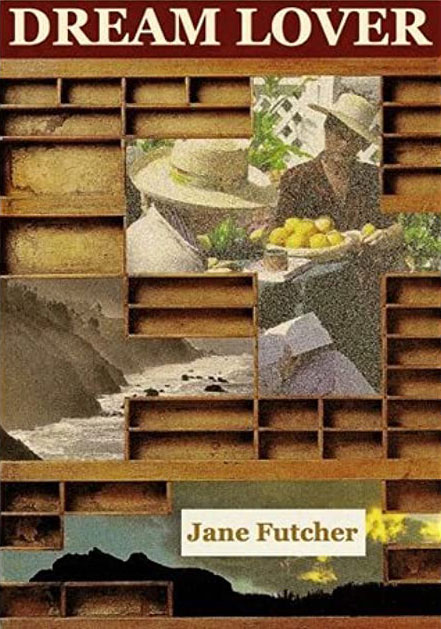
Dream Lover

by Jane Futcher

Kate Paine is a quiet lesbian artist. Ellie Webster is a married, seductive socialite who always has a woman “on the side.” Twenty years ago, the two women had a brief affair at boarding school. Now in their forties, they’ve met again. Suddenly, love flares up anew, and neither Kate nor Ellie’s lives will ever be the same.

Chapter Three

Kate tumed onto the live-lane freeway, heading south for Turkey Run. Three weeks had passed since the strange evening in Mill Valley with Ellie and her friends. Despite the dazzling house and the sexual innuendos, seeing Ellie again – so suburban and even matronly – had been almost anticlimactic. But since that evening something inside Kate had shifted. Kate’s energy and concentration increased as she painted. She’d begun a new Gina painting from photographs, a Rousseau-like dream portrait of both of them standing side by side, a jungle of birds-of-paradise, bougainvillea, and tiger lilies closing around them.
Click to Read More

Reviews

“Kate Paine knows she’s playing with fire when her lips touch those of her high school crush, now married with children. But she can’t stop herself. In this page-turner, Futcher makers her point brilliantly: There’s no flame like and old flame.” Sandra Scoppettone, author of Let’s Face the Music and Die and Trying Hard to Hear You.

“Jane Futcher’s novel, Dream Lover, is absolutely wonderful – compelling, humane, sometimes funny, sometimes sad, beautifully written and wise.”
Anne Lamott, author of Bird by Bird and Hard Laughter.

Women Gone Wild

by Jane Futcher

The adventures of two city slickers who leave their urban footprints behind and learn to love rattlers, bears, pot growers, two dachshunds and each other. Anyone who’s ever dreamed of chucking it all and moving to the country will find Women Gone Wild a funny, provocative and engaging story. And it’s all true.

Chapter One

Looking for Land in All the Wrong Places!

We stood before a shingled shack that had been described in that day’s classifieds as a “see-to-believe creekside getaway near the Russian River, with guest cottage and private redwood grove.”

The creek, now barely a trickle, apparently ran through this house in the winter, which might explain why the entire structure listed to one side. The redwood grove was a single looming tree growing so close to the foundation that its roots had hoisted the garage six inches off the ground. We could almost hear the buzz of happy termites munching on the floor joists. Click to Read More

Review

“I loved this book — it’s funny and genuine, informative and entertaining, an easy read (and one that’s hard to put down once you get started on it) thanks to Jane’s honest, humorous and conversational style. I laughed out loud at some points, chuckled at others; I shook my head in shared understanding reading some of the passages, thought about some things in a new way reading others. By the end of the book I felt as if I knew these women and their friends, and I had half an idea to just run up to Cherry Creek/Willits to say ‘Hi!,’ and maybe take a dip in their pond. It’s a wild ride these women took (and are still taking) and I’m so glad Jane Futcher shared it with us all in this keeper of a book.” — Mel, an Amazon reader

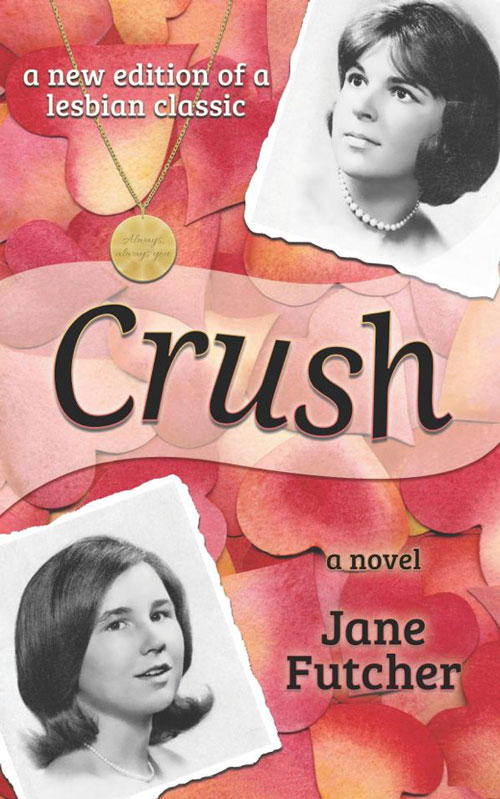
Crush

by Jane Futcher

It wasn’t easy fitting in at an exclusive girls’ school like Huntington Hill. But in her senior year, Jinx finally felt like she belonged. Even her dream of going to art school in New York City seemed more real every day. And best of all, Lexie wanted her for a friend. Beautiful, popular Lexie, who could have anything or anyone she wanted. The other girls said it could never work – Lexie was too spoiled, too demanding. But just being near Lexie made Jinx feel dizzy and scared and wonderful at the same time.

Chapter One

Our friendship began on a clear, crisp October after- noon one month after the start of senior year. The Warren Commission had just announced that a single gunman, not a conspiracy, had assassinated John Fitzgerald Kennedy. In Jackson, Mississippi, the public schools were integrated without violence. And in a few weeks, the names Barry Goldwater and Lyndon Baines Johnson would be posted in every polling booth in America. But at Huntington Hill, it was the day before the second hockey game of the season, and they had put me back on the team. Click to Read More.

New introduction by Dr. Marny Hall

“Originally published in 1981, Crush became an instant bestseller in the lesbian community, where reviewers and booksellers praised the novel for its engaging characters, dry wit, page-turning plot and moral sting. The book was among the first novels written in the voice of a teenaged girl upended by the exhilaration of new love for someone of her own sex. Caught in the thrall of attraction to the beautiful and bad Lexie Yves, Jinx Tuckwell hovers on the edge of ecstasy, teetering dangerously close to what she calls ‘the deep end.’”
Dr. Marny Hall, clinical psychologist and author of The Lavender Couch and The Lesbian Love Companion

Reviews

Praise for Jane Futcher’s Crush
“The emotional facts of this novel ring true. Jane Futcher has tried to present the confusing, terrifying dilemmas that accompany any step out of the narrow band of acceptable behavior that society tolerates.”
— Dorothy Allison, author of Bastard Out of Carolina, in New York Native

“The characterization is outstanding; the hurt, bewildered Jinx; her loyal roommate; and the smooth, calculating headmaster. Lexie is a superb portrait of a fascinating but unreliable and dangerous personality.” — The Horn Book magazine

“A good ear for dialogue and a good eye for a scene and a good memory for the sickening incomprehensions of adolescence.” — Helen Vendler, professor and literary critic for the New York Review of Books, in a letter to the author

New Year’s Resolutions 2021

By Jane Futcher

cropped-cropped-img_8332-1.jpegHow many times have you resolved to exercise every day, ban sugar from your diet and write no matter how many crazy things are going on around you?

I’m certain I’ve made those pledges every year since I started writing down my resolutions in 1902. Correction: 1962.

Have I succeeded? While I’m sleeping on New Year’s Eve I’m pure as the driven snow. But come January First, when I’m supposed to be eating black-eyed peas, I spot a chocolate croissant at Starbucks or a friend tells me I can’t miss the best TV series ever made that is about to air or I get reach into my top drawer for hiking socks and find I simply must clean out the entire closet between 10 a.m. and 2 p.m., when I’d planned to walk and write.

This year I know my resolutions will stick. After all, COVID is still a life-threatening menace despite the new vaccines — how the heck do you get one?— despite the masks, despite the social distancing we attempt going the wrong way down the aisle at the grocery store.

This year will be different, I’m sure. After all, if the nasty virus strikes us down, and we haven’t achieved our life’s goals, we’ll be miserable. I know I won’t die happy if my life plans are sitting like the dirty laundry in the basket in my closet?

This year COVID will help me say “no” to that croissant, no to that thrilling TV show and no to that sudden project that sabotages my writing and walking.

It shouldn’t be hard. I’ve frozen the cake and cookies left over from Christmas. I’ve used up all our WiFi gigs watching “The Queen’s Gambit” anyway. And I’ve found hiking boots that don’t hurt my feet. I’m on my way. How about you?