How We Met

Blind Date

My knees are shaking. It is June 1990. I’ve never met the woman whose doorbell I’m ringing. Her house is red with white trim and a palm tree in the front yard. It’s California, after all.

The door opens. Whoa! She is blond and freckled, with kind blue eyes and a smile as bright as the red roses wrapped around her porch. 

“Jane?” 

“Erin?” I gulp. I’m forty years old, but I’ve never been on a blind date. A mutual friend thought we might like each other because we are both avid readers, single, and looking for love. 

“Come in.” Erin turns to someone standing behind her in the hallway. “Nam Kirn, this is my friend Jane. Jane, this is Nam Kirn, my daughter.”

Her daughter, sixteen, is also gorgeous and freckled, wearing a white turban and jeans. She quickly retreats to the TV room.

The fact that Erin has introduced me as her “friend” although we have never met makes me wonder if she’s “out” to her daughter. 

After dinner at a Chinese restaurant, we go a little art cinema nearby to see a film called Longtime Companion, an emotional drama about the AIDS epidemic. By the end of the movie, I am sobbing. I wonder what’s happening to me. I rarely cry and never in front of strangers.

We walk in the hills near her house, under the full moon. She is a homebirth midwife, refers to “catching” babies, not “delivering” them, and says she lived in an ashram for ten years with her ex-husband, who is still part of the spiritual community. Her daughters went to boarding school in India.

“Wow,” I say. “That’s a long way to go.” 

“My ex- and our teacher pressured me to send them there, and I went along,” she swallows. “What’s it like to write a novel?”

 “Hard,” I say. “I do massage to support myself.”

At the end of the evening, we stand on her doorstep. “I’m going East tomorrow to see my father,” I say. “Can I call when I get back?” 

“Where does he live?”

“Philadelphia,” I say. “But I’m flying to Maine to go sailing with him and his girlfriend and an ex.”

“An ex- of yours?” She looks at me hard.

“She’s my best friend.”

“Cool,” Erin says. “I hardly know my father. My parents split when I was little.” 

“I met someone,” I tell Catherine, my ex-, as the sloop sails past Dark Harbor, Maine. “We had a blind date.”

“Is she crazy? I can’t take another of your crazy girlfriends.” 

“Completely sane. Beautiful and smart. A nurse with two daughters.”

Catherine looks at me skeptically. “Is she a lesbian?”

“Sure seems like it,” I say, remembering her intense gaze as we said goodnight under the full moon.

Erin calls two days after I get home. ‘I’d like to book a massage with you.”

“Is that a good idea?” I can’t catch my breath.

She sounds startled. “You said you were a masseuse.”

“I am.” How to explain? “The thing is, I really like you, and I’m not sure I can maintain. . . my professional distance.”

She is crying. Crying? What have I said?

“Please,” she says. “Please.”

 We set a date. I give her a massage and maintain my professional distance.
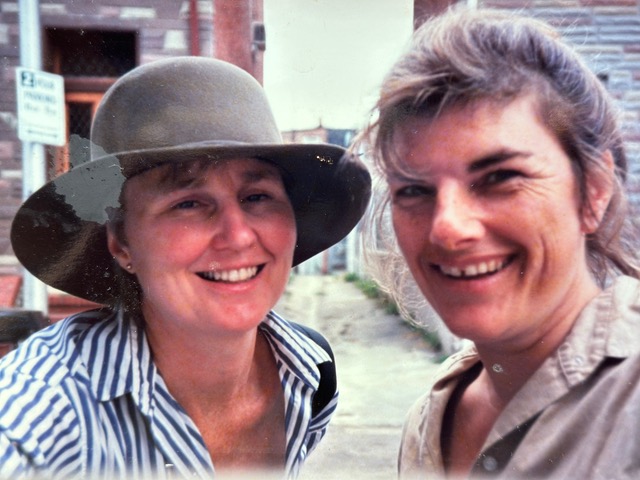
We have been together thirty-five years. We bought land years later in the mountains of Mendocino County, where we built a cabin and a house. Erin morphed into a hospice nurse, and I kept writing. As COVID ended, the hills felt too isolated, and we moved south to Sonoma County, to an over-fifty-five “leisure” community with a boisterous, fun, and active lesbian support network.

We play ping pong with the “Rainbow Women,” leap around a swimming pool at water aerobics, and hike in the nearby hills. We dance to Sixties cover bands on Monday nights and fight our government’s lean toward fascism at local protests.

Our love was born under the full moon, with tears, Chinese food, and loving kindness. We are blessed.

My newest book Heat is out now. Order here!

Death by Turkey Bag

Erin and I had only been living in our house in Sonoma County’s Oakmont Village, an  “active living, over-fifty five” community for one month when the Neptune Society invited us to a free lunch at the Golf Club to a discuss a discount cremation package that was 10 percent off if we filled out the paper work that day, and 25 percent cheaper if we died before the chicken Caesar salad was served.

We were tired of unpacking and boxes everywhere, and I was thrilled by the presentation — everyone was so nice and friendly — and I signed up for the cremation package immediately. I wanted to have all the details ironed out and paid for so Erin’s adult daughters wouldn’t have to fret when we passed peacefully away in the night.  

Erin soon found a cheaper deal with another cremation company — she’s expert at finding deals— when our new friend Jessie—that’s not her real name — invited us and a few other friends to her house for a demonstration of how to use of nitrogen gas to terminate yourself when you are ready to die. I was all intrigued. All in. Not Erin. She’s not convinced she wants to kill herself when the time comes.

It was an odd and sober event, sort of like a Tupperware Party,  with hot tea and homemade chocolate chip cookies, only no one was selling anything, and the goal was learning how to commit suicide in a painless way. Eight of us sat around Jessie’s dining room table while she and a friend, who had assisted in her terminally ill daughter’s death, demonstrated how to put a plastic turkey-baking bag over your head, connect it via a silicone tube to a tank of nitrogen gas you buy at a farm-supply store, and tie the bag loosely around your head. Turn on the nitrogen, et voila, you’re unconscious in about fifteen minutes and dead within an hour.

It was a sobering conversation, and I was grateful for everyone’s honesty and compassion. It turned out several of the guests had been through the agonizing death of a friend or family member who’d felt their only alternative to a prolonged, painful illness was suicide by firearms, a devastating prospect for them and their families.

Jessie explained that you buy the gas at farm supply stores, but if they ask, you don’t tell them you want to buy the nitrogen to kill yourself when you’re mortally ill. You tell them you want to put the gas in your truck tires. Note to self: Find out why you put nitrogen in tractor or truck tires.

Erin is not enthusiastic about the nitrogen gas as a way to terminate her life, or mine, and we haven’t bought any yet. We’re both in excellent health. But I plan to get a small tank. You don’t need a lot.

I like being free to talk about death. You don’t find that in everyone. We even have a club at Oakmont called Cafe Mortel, where we talk about death. The speaker last week showed us how to prepare a chart where we write down exactly how we want our final exit to be: What songs we’d like played or sung to us by our friends or the Harmony Choir; who we wish to or who we really DON’T want to visit us at the bedside; even what view we’d like to gaze at from our window when we’re stuck in bed. All that, of course, is in addition to having completed our living will and right-to-die documents. There are plenty of meetings that help you deal with that. 

But this nitrogen gas could be a goddess-send. If you’ve read the book by Mitch Album, who wrote Tuesdays with Morrie, you know it’s not all that easy to die, even in right to die countries like Switzerland and in some states, because you have to be six months from death and totally rational, which is a real problem if you have dementia.

Don’t get the wrong idea. Erin and I are living life to the fullest here at Oakmont. We hike several times a week, play pingpong with the Rainbow women Tuesday nights; play golf with the Women’s Nine and Wine on Wednesdays (minus the wine for me — I’ve been sober since 1983. I line dance on Wednesday nights, do water aerobics with Erin on Tuesday and Thursday, and march for justice at least once a month.

It’s all good, as they say. I’d like to tell you more, but I have to run to my writing group, where the timed write exercise will be — “feelings about your death,” of course. Or pets in your life. I haven’t decided.

I’ll tell you about our dogs next time. Or maybe I’d rather talk about ordering our tombstone in Baltimore. It’s up now and waiting for us.

Footnote: My new book Heat is out – Order now!

Hello, Goodbye, Dream House

From Let Me Tell You Before I Forget
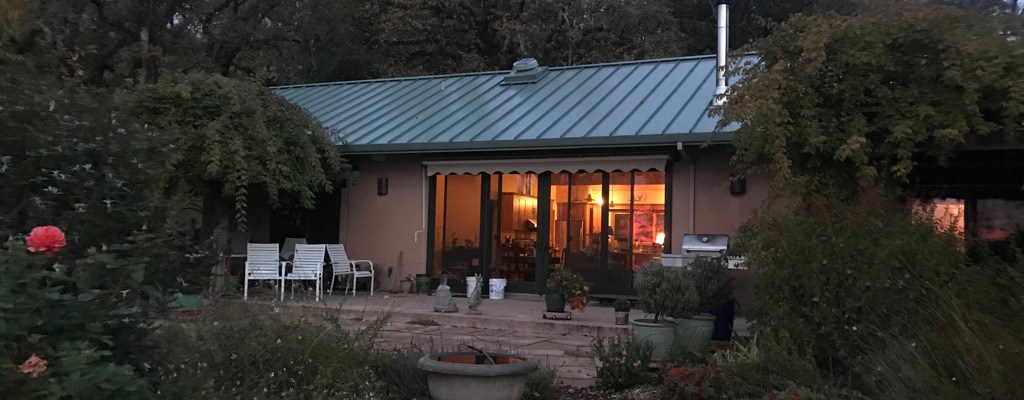
In 2004, my wife Erin and I built our dream home in Mendocino County, on one hundred and sixty-two acres in the mountains near the tiny town of Laytonville. 

We designed our house as a place we could live, grow old and die in. It was fire proof, off the grid and all on one level. We had wide doorways for our wheel chairs, when and if we needed them; pull bars by the toilets, and seats in the showers. We were all set for illness, death and catastrophe of every sort.

In the event of a wild land fire, we planned to jump into our pond and wait until the flames passed. Stuck in snow, our pantry was so well stocked we could live for a year. If we got really sick, Erin was a hospice nurse and could steer us safely and painlessly to the other side. 

What could possibly go wrong?

Fast forward to 2019. Wild fires raged around us. Our pond was so leaky that if we’d jumped during a fire, we’d hit our heads on the rocky bottom or be attacked by the rattlesnakes that lurked at the pond’s edge. Our neighbors were getting too old to rescue us if a tree fell on our heads, and crossing the border was getting too dangerous for the fabulous family of Mexicans who worked for us twice a month. Our plumber, the only licensed contractor who served our area, announced he was retiring. The other plumber died of COVID. 

On a summer evening in 2021, some dear neighbors invited us for dinner to watch a documentary they’d recorded on aging lesbians in Willits, the town where we got our mail. We knew most of the women in the film, but many of them were dead or had moved to less remote towns and cities. But the film included a segment on a lesbian group called the Rainbow Women living in Oakmont Village, an over-fifty-five community in Sonoma County’s Valley of the Moon.

We’d never heard of Oakmont Village, but we Googled the Rainbow Women, and by the next morning, Erin was on the phone to the group’s president, learning all about this perfect little town in wine country. The week after that, we were looking at houses. Three months later, with many tears, we packed our dream house, sold it to a couple from L.A.’s San Fernando Valley, and moved with our two enormous country dogs to a 1400-square foot tract home in Oakmont Village.

Unlike our dream house, our new house had steps up to the entry, narrow doorways our would-be wheelchairs would never fit through, and bathrooms so small we couldn’t brush our teeth at the same time. It’s so poorly insulated, we go outside in winter to get warm, and our neighbors are so close we can hear them pass gass if they eat too many beans or burritos.

But….we are near doctors, hospitals, friend’s, Erin’s younger daughter, grocery stores and Dollar Generals. We have mail delivery five days a week, and big trucks pick-up our garbage, recycling and organic matter on Thursdays. No more dump runs in the truck. Beset of all, the streets are overflowing with plumbers, electricians, mobile dog groomers and gardeners.

We’ve learned a few things in the three years we’ve lived at Oakmonth Village:

—If you need a doctor for your knee or hip replacement, a cardiologist for your A-fib, a dermatologist for a basal cell carcinoma, a contractor to replace your kitchen counters, hang out in the jacuzzi after morning water aerobics classs at the West Recreation Center. Just the other day a nice woman told us about an amazing new drug she been prescribed to improve her memory, but she’d forgotten its name.

What I really love about senior living is the freedom we have to talk about death. But that’s a story for another day. Let the real retirement begin!

Footnote: My new book Heat, comes out in June!